


soho vocal tuition
Learn the vocal technique used by Michael Jackson, Stevie Wonder, Madonna, Barbra Streisand, Prince and over 135 Grammy Award winners.
Soho Vocal Tuition is home to some of the UK’s most experienced vocal coaches, working with singers at every stage – from complete beginners to professional artists.
We have worked with:

Grammy-winning recording artists
Platinum-selling artists and songwriters
#1 selling artists
BRIT nominees
Mercury Prize nominated artists
Glastonbury artists
X-Factor finalists
West End theatre stars
Actors, rappers, and countless beginners
“Thank you for all the lessons. Tour went very well, and I was very pleased with my singing - better than ever. Even easier than the last time we played Vegas. Whatever you’re doing definitely works!”
We work with
Professional Artists
Working with recording artists, touring performers and singers managing demanding vocal schedules.
Developing Singers
From beginners to developing performers – building consistency, confidence and reliable technique.
Inclusive & Supportive
Welcoming a wide range of voices, backgrounds and artistic goals.
Children
We generally start teaching children from age 12.
Please contact your chosen teacher about lessons for younger children.
Our Approach
Our Approach
our expertise
We specialise in private singing lessons for all levels, with a focus on vocal technique – identifying underlying issues and resolving them, so singers can build reliable control and focus on performance.
WHAT WE CAN HELP WITH
Tension and vocal fatigue
Cracks and breathiness
Mixed voice and connecting registers
Breath support and posture
Vocal control and confidence
Belt, power and range
Tone, resonance and ease
Flexibility, dynamics and expression
speech level singing
Our teaching is informed by Speech Level Singing (SLS) – the vocal approach used by artists such as Michael Jackson and Stevie Wonder – alongside ongoing work in modern vocal science and evidence-based training.
Speech Level Singing was designed to connect the registers of the voice without cracks or strain, resulting in a strong, flexible and effortless voice.
Modern vocal science has refined the teaching process, allowing results to be achieved more quickly.
Integrated & holistic Approach
Our work brings together the SLS vocal technique, artistry and performance, vocal health, and mind-body connection – giving singers reliable control without compromising their natural sound.

WHAT MAKES US DIFFERENT
WHAT MAKES US DIFFERENT
world-class technique
Trusted by Grammy-winning and Platinum-selling artists, West End performers, BRIT nominees and touring musicians.
Our teaching is informed by the world-renowned ‘Speech Level Singing’, alongside ongoing work in modern vocal science.
VOCAL diagnosis
We assess your current vocal habits using a set of simple diagnostic scales, alongside your vocal history and goals.
This allows us to quickly identify how your voice is currently coordinating, and where change is needed.
quick results
Our approach combines experience with current vocal science to make targeted changes quickly and reliably.
Nothing is overlooked – technique, vocal health, body awareness and performance all work together.
simple explanationS
We translate complex vocal concepts into simple, usable adjustments you can apply immediately.
The aim is clarity and control, without unnecessary technical overload.
Tailored to EVERY voice
We work with all voices and identities, with extensive experience across a wide range of singers.
We don’t use generic warm-ups. Each lesson is tailored to your voice – your level, experience, goals, musical background and pace of learning – adapting as you develop.
Keep your uniqueness
You don’t lose what makes your voice unique.
We help remove the limitations, so you can choose how your voice sounds – whether that’s clean, rough, powerful or subtle.


INDEPENDENT BUSINESSES
Ed and Anna operate independently as separate businesses, so lesson bookings and payments are made with your chosen teacher via the Booking page.
What happens in a Singing Lesson
What happens in a Singing Lesson
Lesson Structure
A typical first lesson is structured along the following lines.
Short chat (first lesson only)
We discuss your goals, experience and any specific vocal issues.
Diagnostics (first lesson only)
You sing a few simple exercises so we can assess your voice and identify what’s working and what needs attention.Targeted exercises (20-25 mins)
You work through carefully chosen exercises to address underlying habits and improve coordination. This is where most of the technical change happens.Apply it to a song (20-25 mins)
The same coordination and technique are applied directly to repertoire, so the changes translate into real singing.Summary and next steps
We recap the session, outline what to practise, and plan the next stage.
As technique improves, expression becomes easier and more natural.

Lesson Prices

Frequently Asked Questions

Our Vocal Method

Anna’s Band
FAQs
Frequently Asked Questions
FAQs
Frequently Asked Questions
how much are lessons?
Please see the Prices section
What is my first lesson like?
See the ‘What Happens In A Singing Lesson’ section above
Do you work with beginners?
Yes, absolutely.
Many people who think they are ‘tone-deaf’ simply haven’t yet developed the coordination needed to match pitch reliably. In most cases, it’s not the ear but the voice that needs training.
We help you build that coordination step by step.
HOW MUCH DO I NEED TO PRACTISE?
Progress depends on consistency.
Like any skill – sport, language or instrument – the more regularly and deliberately you practise, the faster you improve. Even short, focused practice between lessons can make a big difference.
how many lesson will i need?
It varies.
A block of 6 lessons is usually enough to understand your voice, identify current habits and begin making changes.
Beyond that, progress depends on:
your starting point
your goals
how often and how effectively you practise
The more consistent the work, the more reliable and ingrained your technique becomes.
Do you teach style too?
Yes – style, expression and delivery are a key part of singing.
We usually develop these once the underlying technique is working more reliably, so you can express yourself with greater ease and control – without losing your individuality.
Do you work with rappers?
Yes.
We can help with projection, pitch control and vocal health, as well as bridging the gap between speech, rap and melody.
Should i bring sheet music?
Not essential.
You’re welcome to bring lyrics, chord charts or sheet music if you have them – especially for less well-known songs. Otherwise, we can provide what’s needed.
We also use Spotify and backing tracks where appropriate.
DO I need to read music?
No.
Exercises are simple and taught by ear, and songs can be learnt using lyrics or recordings. Sheet music is optional.
Can I bring my own backing-track?
Yes, especially if it is an original track.
CAN I RECORD MY LESSON?
Yes – we recommend it.
Recording helps you track progress and remember key exercises between sessions.
What technique do we teach?
Our teaching is informed by Speech Level Singing, alongside ongoing work in modern vocal science.
The aim is simple: to develop a voice that is balanced, efficient and free from unnecessary strain, with smoothly connected vocal registers – allowing greater control, range and expression.
SHOULD I PREPARE A SONG?
You can, but it’s not essential.
There’s no need to perfect it – we’ll work on it together in the lesson. You can also use lyrics as a guide.
Do we offer discounts?
Yes, a 10% discount is available when booking a block of 6 lessons in advance. Please ask your teacher upon booking.
You can still book flexibly – there’s no requirement to have regular lessons or pre-book specific times. Lesson times can vary, and sessions don’t need to be scheduled in advance, only paid for. Our standard cancellation policy applies.
Do you offer group lessons?
Not at the moment.
SINGING TECHNIQUE
How the voice works – how we fix it
SINGING TECHNIQUE
How the voice works – how we fix it

how we teach
The vocal method we use helps to connect the different registers of the voice.
This often means finding or fine-tuning the lower register, then finding the upper register, then learning how to join them seemlessly together.
Then the voice is able to transition smoothly from lowest to the highest note - rather than break, crack or strain - the most common and frustrating problems - and you have the freedom to sing how you want.
The voice has one big quirk though… You cannot see what you are doing. Your vocal cords and larynx are hidden inside your neck. This is unlike almost every other skill you have ever learnt. It is therefore useful to know a few key things…
understanding your instrument
There are four main concepts that will help you understand your voice:
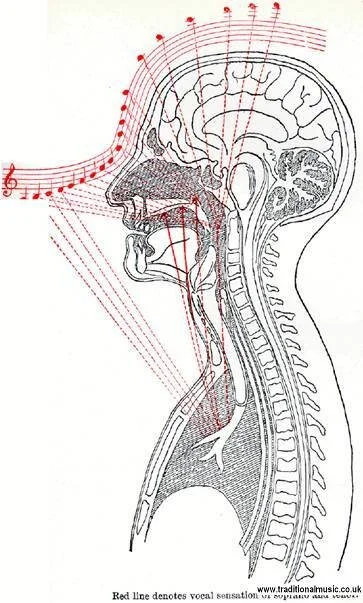
When you sing, you may feel the ‘resonance’ (or the vibration of the sound produced from your vocal cords) move up and down your vocal tract. The resonance feels like it moves up from the chest, into the mouth, behind the soft palate and nose, then further up in vertical direction in the head.
The vocal cords must be able to vibrate together AND adjust properly.
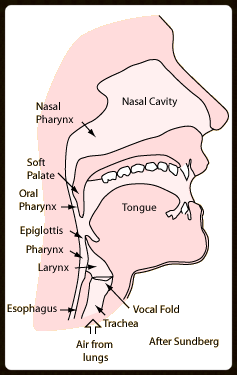
The larynx must stay in a mostly neutral position (i.e. not be lifted up, not be pushed down), and it must remain as stable as possible (i.e. not move up and down). If not, the tone of the voice will vary, and the ‘ease of production’ will vary.
Your breath must come from your diaphragm (and ribs). This gives the most control on exhalation, and also prevents any unwanted tension from your chest affecting your throat muscles. (It also looks better too!)
“What I like about this - and maybe it’s just your teaching method - but I feel like it’s very instinctive and I can just pick it up, rather than it being mental and then I have to think about it and translate the thought into action. The process itself takes you there, rather than you having to think.””



PROPER VOCAL FUNCTION
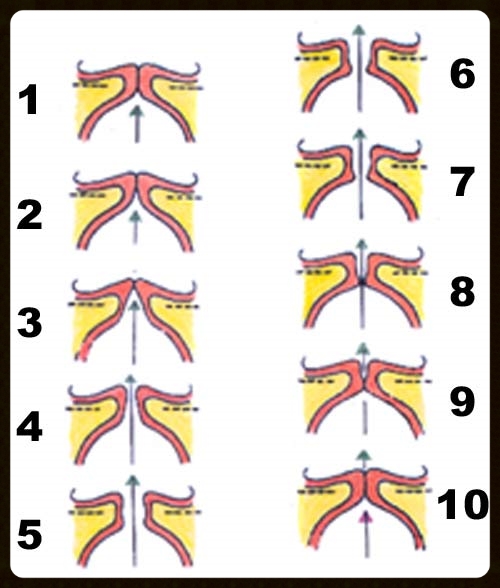
Vibrating cords
Basically, if the vocal cords are allowed to vibrate together in a flow of air they make sound.
adjusting cords
For good singing, this vibration must happen with the correct amount of vocal cord ‘adjustment’. The vocal cords cannot be too thick or too thin - they must be ‘just right’, throughout the entire range.
If they are too thick (usually in chest voice, or at the top of chest voice), there will be tension in the voice
If they are too thin (usually when moving into head voice), there will be cracks in the voice
neutral larynx
If the vocal cords are adjusting ok (not too thick or thin), but the larynx raises, then the tone might be consistent but it will be squeaky like a chipmunk or the Bee-Gees. (The Bee Gees are amazing but this should be an option!)
the result
If the cords are adjusted correctly, NOT squeezed then they can adjust in pitch in a controlled manner with even tone/timbre.

RESonance & vocal BRIDGES
As you sing, you may feel the vibration of your voice. As you sing higher or lower notes, you may feel this vibration move up and down your vocal tract.
What you are feeling is the ‘resonance’ - essentially the vibration of the sound bounce around inside the cavities of your mouth, throat, nose, and chest. This movement from one place to another - almost from one body part to another - is often called a ‘bridge'. A bridge is better than a break, as, by definition, it is joined up and is therefore better controlled.
“Feeling the resonance in the body can almost help singers VISUALISE their voice! (There’s nothing else to see - sound is invisible, and the larynx and vocal cords are covered by skin!)”
As a result of singing properly through a bridge, the resonance can often be felt to ascend up the vocal tract. It moves from the chest, into the mouth, behind the soft palate, and into the head. This helps singers being controlled, even, and connected, from bottom to top - without breaks, cracks, tension or noticeable changes in tone/timbre (unless stylistically desired).
'twang'
Providing there is no unwanted squeezing, you can raise or 'tilt' the larynx to add twang into a voice. This helps with projection but also helps the vocal cords adjust in pitch. (NB - Laryngeal tilt is not the same as laryngeal squeeze.)
To give the voice a stronger, fuller-sounding tone (as well as just twang), the larynx should be lowered back to a neutral position, with the tilt remaining but not the high larynx. And never any squeeze.
NOT 'OVER-TRAINED' or boring
Like a well-trained athlete, a healthy voice should be able to do more, for longer periods of time, with more stylistic options available, have more flexibility, more strength, have a more interesting tone, less pain, less wobbly, and ultimately be nicer to listen to.
Stylistic changes in tone - e.g. flips, yodels, falsetto, twang, distortion, etc. - can be added when required.
“Your vocal style should be a collection of your strengths, not your weaknesses.”